


Act I · Pula railway station · 10:30-12:00 · opening ceremony
GrandZaro Choir
A song recorded by the newspaper Naša sloga in 1884 evokes the arrival of the first train.
Conductor Serena Bonassin · Nives Galić · Sedina Cerovac
The Young Man Who Wanted to Dance the Waltz – part one
An encounter on the platform opens the day and leads the audience into a world of music and dance.
Šandor Slacki · Nina Petrović
Welcome in the languages of the Monarchy
Pula welcomes its guests and opens the door to a new meeting of cultures.
A song dedicated to the railway
Verses published in Naša sloga in 1884 revive the story of the railway’s arrival in Pula.
Sedina Cerovac · Nives Galić
Meeting the rhythm of the train
A dance scene transforms the mechanics of an arriving train into a waltz.
Dance ensemble
Arrival of the train and historical figures
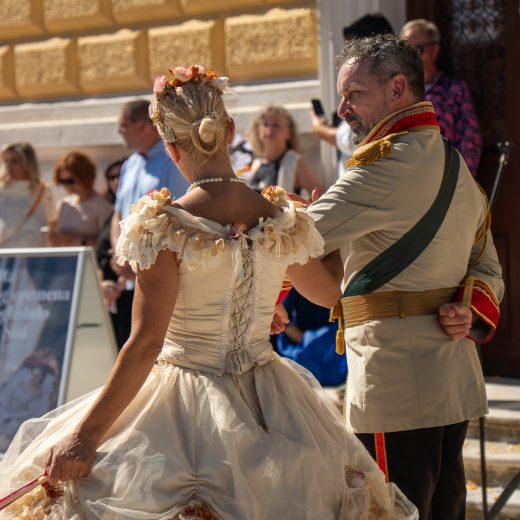
Historical figures of the Monarchy step down onto the platform.
The way it used to be…
The sounds of the Pula Wind Orchestra recreate the atmosphere of the city’s former railway station.
Pula Wind Orchestra · conductor Jasmina Lorin
Stories from Istrian railway tracks – yesterday, today and tomorrow
Live storytelling recalls the Austro-Hungarian railway and Pula as a transport centre of the Monarchy.
Distinguished guest Assoc. Prof. , PhD
A conversation between Jurina and Franina
Two familiar Istrian characters comment on the train’s arrival and the life of the city.
Šandor Slacki · Igor Šaponja
Ceremonial opening and communal dance
The programme is opened by and Sanja Cinkopan, Director of the Pula Tourist Board, with addresses by representatives of the Istria County and the City of Pula. The Pula Wind Orchestra and a communal dance herald a new beginning.
H.I.R.H. Archduke · Gottfried O. Rieck, owner of the Majestic Imperator Train de Luxe · conductor Jasmina Lorin
Act II · House of Croatian Defenders, Marine Casino · 17:30-19:30
Prominent women of the Austro-Hungarian era
A panel brings together Paula Preradović, Giuseppina Martinuzzi, Marija Jurić Zagorka and Ivana Brlić-Mažuranić. The discussion explores the position of women, education and emancipation, art and fashion, and humanitarian work.
A woman’s boudoir
Alongside the panel, a boudoir presents dresses by costume designer Elica Iljoska. Costumes and rituals evoke women’s everyday life during the Monarchy.
Elica Iljoska
The flautist evokes the role and beauty of women
A musical interlude accompanies the stories of prominent women and their era.
Samanta Stell
A conversation about the women of the Monarchy
The encounter connects historical figures, culture, literature and a contemporary reflection on the position of women.
, MA in Culture and Tourism · moderator Assoc. Prof. , PhD · Prof. , PhD · Marlena Lakić · Slavica Porubić Kukal, MA in History Education · Sedina Cerovac
Address by the distinguished guest
The programme is supported by H.I.R.H. Archduke , Archduke of Austria, Prince of Tuscany, Royal Prince of Hungary, Croatia and Bohemia.
Fundraising – For a better future for our children
This initiative grew from a wish to use the stories of women who shaped history to highlight timeless values: women as bearers of life, mothers, educators and builders of the future. Children are our greatest treasure and an investment in a better society, so the panel carries a strong humanitarian message alongside its cultural and educational dimension. Donations are dedicated to children of the Ruža Petrović Community for Children, supporting their upbringing, education and equal opportunities for the future. Visitors support this worthy cause by purchasing a selection of products.
Act III · Our Lady of the Sea Church, Naval Church · 20:00-21:00
Matilda Barry awaits new stories
A staged introduction opens the evening programme in the Naval Church.
Sedina Cerovac · Igor Šaponja
Musical nocturne
A chamber concert intertwines flute, tenor, piano and choral voices in the Naval Church.
Samanta Stell, flute · Ronald Braus, tenor · Sandro Vešligaj, piano · Lino Mariani Pula Mixed Choir
Pouring silence into the night
The official programme of the first day ends as the audience disperses into the Pula night.
 Circolo, 23/08/2026